



Teen Patti Tie Rules: Who Wins with the Same Hand Type?


Both players have a Pair, or both have an Ace as their highest card—who wins? Understanding Teen Patti Tie Rules starts with one distinction: having the same hand type does not automatically mean a tie. You usually need to compare the relevant card ranks before deciding whether the hands are equal.
This guide uses one standard 52-card deck, no Jokers and no suit-based tie-breaker. Each example is a separate deal. Special modes may use different sequence rankings or tie-settlement rules, so check your table’s instructions.


Compare the Hand Type Before Individual Cards
First, identify each player’s hand type. Then compare the card ranks that matter within that category. Only when all relevant ranks match do you apply the rule for an exact tie.
For example, an Ace kicker cannot beat a higher Pair. Similarly, a Pure Sequence beats an ordinary Sequence even when both contain the same ranks. You cannot decide the winner simply by finding the highest individual card or adding the values of all three cards.
If you need a refresher on the ranking order, read the Teen Patti Sequence List before working through the comparisons below.
How to Compare Hands Within the Same Category
Each hand type has its own comparison method. Identify the deciding cards first, rather than letting one high card distract you.
Trail / Trio: Compare the Rank of the Three Matching Cards
When both players have a Trail, compare the rank of their three matching cards. For example, 10♠, 10♥, 10♦ beats 7♠, 7♥, 7♦. There is no kicker to compare.
With one standard deck and no Jokers, two players cannot both hold a natural Trail of the same rank. That would require six cards of that rank, but the deck contains only four.
Pure Sequence: Follow the Agreed Sequence Order
When both players have a Pure Sequence, compare their positions in the table’s sequence ranking. For example, 9♥, 10♥, J♥ beats 8♣, 9♣, 10♣.
Sequences containing an Ace need special attention. The order of A–2–3 and A–K–Q can differ between modes, so confirm it before comparing. If both Pure Sequences have identical ranks, they are equal under the no-suit-ranking rules used here.
Sequence: Suits Do Not Break Equal-Rank Hands
Ordinary Sequences also follow the applicable sequence order. For example, 6♣, 7♦, 8♥ beats 5♦, 6♠, 7♣.
If the hands are 8♣, 9♦, 10♥ and 8♦, 9♠, 10♣, both have the same Sequence ranks. They are equal under a no-suit tie rule. However, if one hand is a Pure Sequence, the hand-type ranking decides the winner first.
Colour: Compare the Highest Card, Then the Next
For a Colour, also called a Flush, arrange the cards from highest to lowest and compare them in order.
Player A: A♥, Q♥, 5♥
Player B: A♣, J♣, 9♣
Both hands start with an Ace, so compare the second cards. Queen beats Jack, giving Player A the stronger hand. Player B’s Nine cannot make up for the lower second card.
Pair: Compare the Pair First, Then the Kicker
The Pair’s rank takes priority over the remaining card. For example, K♠, K♥, 4♦ beats Q♠, Q♥, A♣ because Kings beat Queens.
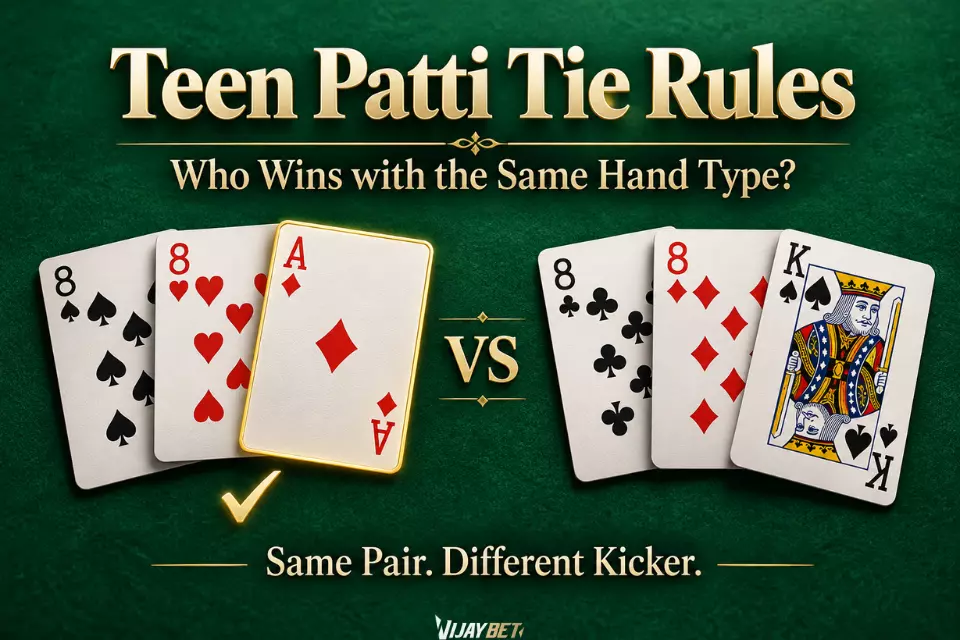
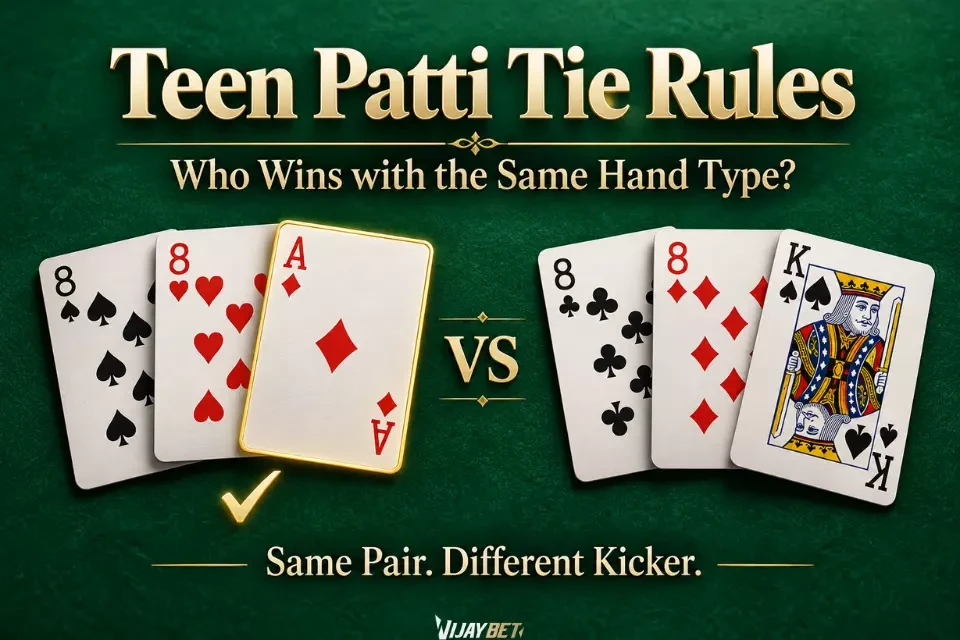
Only when the Pairs match do you compare the remaining card, known as the kicker. With 8♠, 8♥, A♦ against 8♣, 8♦, K♠, both players have eights, so the Ace kicker beats the King kicker.
High Card: Compare All Three Cards in Order
When neither hand forms another category, compare the highest card first, followed by the second and then the third if needed.
For example, compare A♠, J♦, 8♣ with A♥, J♣, 6♦. The Aces and Jacks match, so the Eight beats the Six. An exact hand tie occurs only when all three relevant ranks match.
Exact Ties: Check the Show and Sideshow Rules
Equal hand strength does not automatically mean the pot is split. You must next check how the comparison happened and how that mode settles a tie.
For example, TeenPatti Royale’s official instructions state that the player requesting a Show loses an exact tie. The same guide describes an accepted Sideshow differently: if the requester’s cards are better than or equal to the other player’s, the other player must pack. These are product-specific rules, not universal instructions for every platform.
Seen or Blind status alone does not decide an exact tie. A Seen player does not automatically lose, and a Blind player does not automatically win. Check the rules for the actual action—Show, Sideshow or an automatic reveal—rather than treating them as interchangeable.
Common Mistakes When Comparing Equal Hands
Many disagreements happen when players carry rules from another game or mode into the current one. These are the main mistakes to avoid:
Common assumption | Correct way to check |
| A hand containing an Ace always wins | Compare hand types first; for Pairs, compare the paired ranks first |
| Spades always beat Hearts | No suit ranking applies in this guide; any special suit order must be explicit |
| The higher total card value wins | Compare the relevant ranks in order, without adding them |
| Matching Pairs automatically tie | Compare the kickers as well |
| Every exact tie means a split pot | Check the mode and the settlement rule for that comparison |
If an app’s result differs from your expectation, note the mode, both complete hands and whether it was a Show, Sideshow or automatic reveal. The two hands alone may not explain the final settlement.
Frequently Asked Questions About Teen Patti Tie Rules
- Q1. Is It a Tie If Both Players Have an Ace as Their Highest Card?
Not automatically. First, check the hand types. If both are High Card hands, compare the second card and then the third if necessary. Matching Aces are only the first step. - Q2. Can a Lower Pair Win Because Its Kicker Is an Ace?
No. The Pair’s rank is compared first. An Ace kicker matters only when both players have the same-ranked Pair. - Q3. Do Spades Always Beat Hearts?
No suit order applies under the rules used in this guide. If a table uses suits to break ties, it must state that rule explicitly. Do not assume another card game’s suit ranking applies. - Q4. Does A–2–3 Always Beat A–K–Q?
No. Check the sequence order for the selected mode. This is a ranking-rule question, rather than an automatic tie between the hands. - Q5. Does the Player Requesting a Show Always Lose an Exact Tie?
That rule exists on some platforms, but it is not universal across all modes and actions. Sideshows and automatic reveals may have different settlement rules.
Check the Tie Rule Before Calling for a Show
Understanding Teen Patti Tie Rules becomes easier when you follow the order: identify the hand type, compare the relevant ranks and check the settlement rule only if the hands remain equal. This prevents you from treating matching Pairs as automatic ties or assuming every equal hand results in a split pot.
Explore more guides on VijayBet to understand hand rankings and comparison actions, then confirm the details against the rules of your chosen table.