






Teen Patti Hand Probability: Why High Card Is So Common


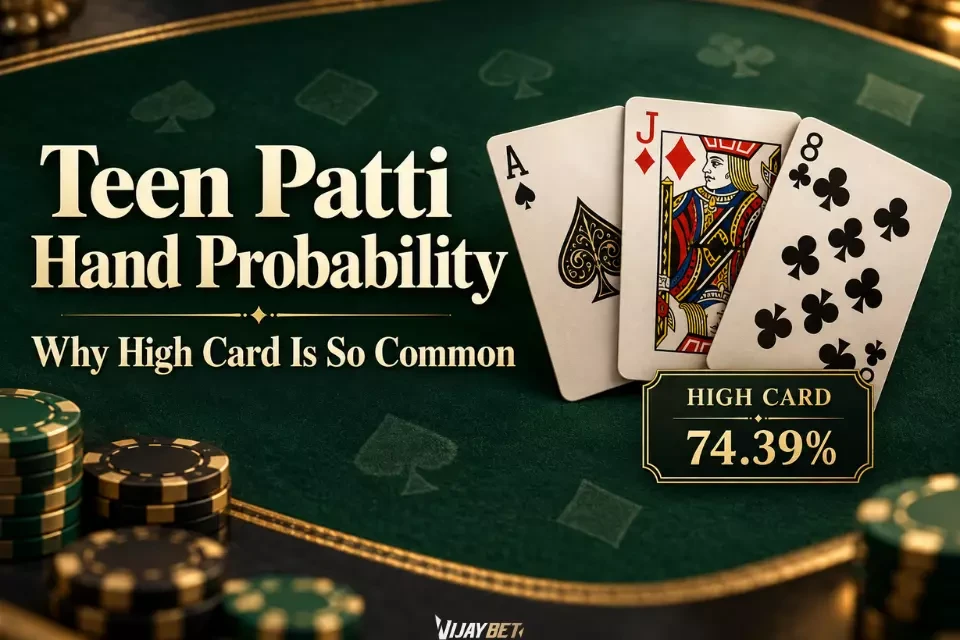
Getting High Card again in Teen Patti can be frustrating, especially when you are waiting for a Trail or Pure Sequence. But in a standard 52-card game, High Card accounts for about 74.39% of all possible three-card hands, while a Trail appears only about 0.24% of the time. These Teen Patti hand probabilities reflect how many card combinations can form each hand—not your chances of winning with it.
This guide compares the probability of each hand and explains why getting a Pair does not guarantee a win, why several weak hands do not make a strong one more likely next, and how opponents, Blind or Seen status, and betting actions affect what you can reasonably conclude during a round.
Table of contents


- How Is Teen Patti Hand Probability Calculated?
- How Often Does Each Teen Patti Hand Appear?
- Why Do You Keep Getting High Card Instead of a Trail?
- Why Is the Chance of Getting a Pair Different From the Chance of Winning?
- What Do Blind, Seen and Betting Actions Tell You?
- Frequently Asked Questions About Teen Patti Probability
- Understand What the Numbers Actually Mean
How Is Teen Patti Hand Probability Calculated?
Before looking at the numbers, we need to define the game. The calculations below use a standard 52-card deck without Jokers. Each player receives three random cards, with no option to replace cards or select the best three from a larger hand.
There Are 22,100 Possible Three-Card Combinations
When the order of dealing does not matter, a 52-card deck produces 22,100 different three-card combinations.
The calculation is:
52 × 51 × 50 ÷ (3 × 2 × 1) = 22,100
For example, receiving A♠, K♥ and 8♦ in that order gives you the same hand as receiving those exact cards in a different order. It is counted as one combination.
With a properly shuffled deck and no known card information, every specific three-card combination is equally likely. A hand category with more combinations will therefore appear more often.
Each Hand Is Counted in Only One Category
Consider 5♥, 6♥ and 7♥. These cards are consecutive and belong to the same suit, but they are counted only as a Pure Sequence—not again as a Sequence or Colour.
For these calculations, both A-2-3 and A-K-Q are valid sequences, while K-A-2 is not. A table may rank A-2-3 differently, but changing its position does not change the number of combinations, provided the same sequences remain valid.
Games with Jokers, replacement cards or special selection rules require separate calculations.
How Often Does Each Teen Patti Hand Appear?
The figures below were calculated by classifying all 22,100 possible three-card combinations under the conditions above. The table is arranged from most common to least common, rather than from strongest to weakest.
High Card Is the Most Common Hand
Hand | Combinations | Probability | How the combinations are counted |
| High Card | 16,440 | 74.39% | All combinations left after removing the other five categories |
| Pair | 3,744 | 16.94% | 13 Pair ranks × 6 suit combinations × 48 possible kickers |
| Colour | 1,096 | 4.96% | All three-card combinations of one suit, excluding Pure Sequences |
| Sequence | 720 | 3.26% | 12 sequences × 64 suit combinations, excluding Pure Sequences |
| Trail / Trio | 52 | 0.24% | 13 ranks × 4 ways to choose three matching cards |
| Pure Sequence | 48 | 0.22% | 12 sequences × 4 suits |
Percentages are rounded to two decimal places, so they may not add up to exactly 100%.
These are the probabilities for one randomly dealt hand. They are not the chances that someone at the entire table receives a particular hand, and they are not your chances of winning.
A Rarer Hand Does Not Always Rank Higher
Pure Sequence has 48 possible combinations, making it slightly rarer than Trail, which has 52. Yet in standard Teen Patti, Trail still beats Pure Sequence because hand rankings follow the game’s rules, not rarity alone. Probability tells you how often a hand appears; ranking tells you which hand wins when cards are compared.
For a refresher on the ranking order, read the Teen Patti Sequence List alongside this probability table.
Why Do You Keep Getting High Card Instead of a Trail?
High Card is not one specific combination. It includes every three-card hand that does not qualify for a higher category, which leaves far more possibilities than Trail or Pure Sequence.
Nearly Three Out of Four Hands Are High Card
A♠–J♦–8♣ is High Card. So is K♥–9♥–4♣.
A High Card hand does not need three different suits. Two cards can share a suit, provided the complete hand does not form a Pair, Sequence, Colour, Pure Sequence or Trail.
There are 16,440 High Card combinations out of 22,100 possible hands. That is why this category appears about 74.39% of the time.
Receiving High Card several times in a row does not, by itself, show that anything is wrong with the dealing. It also does not mean a stronger hand must arrive soon.
One Trail in 425 Hands Is an Average, Not a Schedule
To form a Trail in Teen Patti, all three cards must have the same rank. Each rank has four cards, with four ways to choose three of them. Across 13 ranks, that gives 13 × 4 = 52 Trail combinations out of 22,100 possible hands—a probability of 1 in 425, or approximately 0.2353%.
This is a long-term average, not a countdown to your next Trail. If the deck is fully reshuffled for each hand, you could receive two Trails close together or go more than 425 hands without one. Previous results do not make a Trail more likely on the next deal.
Why Is the Chance of Getting a Pair Different From the Chance of Winning?
Seeing “Pair: 16.94%” can lead to a misunderstanding. That number describes how often a Pair is dealt—not how often a player holding a Pair wins.
Hand Probability Describes Your Cards; Winning Requires a Comparison
The 16.94% figure applies before the deal, under the stated conditions and without known card information.
Once you have a Pair, the questions change. What is the Pair’s rank? What is your third card? How many opponents remain, and what hands could they hold?
A Pair of Aces and a Pair of Threes both belong to the Pair category, but they do not have the same strength against other Pairs. When two players have the same Pair, the third card—the kicker—can decide the result.
So, the chance of being dealt a Pair cannot be used as your chance of winning after receiving one.
More Opponents Change the Situation
Facing one opponent is different from facing five. With more opposing hands to beat, the winning chances of the same cards can change.
However, you cannot simply multiply the single-player percentages to calculate an exact table-wide probability. For example, five opponents do not mean a precise 5 × 4.96% chance that at least one has a Colour.
Everyone receives cards from the same deck, so the hands are not completely independent. A calculation for “at least one player” must also account for cases where more than one player receives that category.
An exact winning-probability calculation needs your specific cards, the number of opponents, any known cards and the applicable rules.
What Do Blind, Seen and Betting Actions Tell You?
The probability table provides a starting point before the deal. Once the hand begins, what players know and how they act become separate questions.
Seen Means You Have Viewed Your Cards
In Teen Patti, Blind means you have not looked at your cards, while Seen means you have viewed them. Seen describes your status, not the action of calling a bet. Depending on the table rules and stage of play, a Seen player may choose Chaal, Pack or another available action.
Looking at your cards helps you assess your hand, but it does not change the cards already dealt or automatically improve your chances of winning. An opponent playing Blind can still hold a strong hand, so you cannot assume they will Pack simply because someone else bets.
A Raise Does Not Prove That Someone Has a Trail
A player may raise because of hand strength, a bluff or their usual playing style. Without enough information, you cannot conclude that they hold a Trail or attach an exact percentage to your own winning chances.
Players who remain after several betting decisions may also have a different hand distribution from players who have just received random cards. The initial probability table does not automatically describe that remaining group.
Betting actions can provide information, but that information is incomplete. Hand probabilities cannot reveal an opponent’s cards or, on their own, tell you when a bet will be profitable.
Frequently Asked Questions About Teen Patti Probability
These answers address the most common misunderstandings about what a probability table can—and cannot—tell you.
- Q1: What Is the Most Common Hand in Teen Patti?
High Card is the most common hand in a standard 52-card game without Jokers. It accounts for approximately 74.39% of all possible three-card combinations. Receiving cards that do not form a Pair or a higher category is therefore very common. - Q2: Is a Trail Rarer Than a Pure Sequence?
No. A Pure Sequence is slightly rarer, appearing about 0.22% of the time, compared with approximately 0.24% for a Trail. However, Trail still ranks above Pure Sequence in standard Teen Patti. - Q3: Does Getting High Card Repeatedly Make a Strong Hand More Likely Next?
No, provided the deck is fully reshuffled for each hand. Previous weak hands do not create a compensating advantage on the next deal. A losing run is not evidence that a Pair or Trail is due. - Q4: Can These Probabilities Be Used for Teen Patti Joy?
Check the rules of the specific mode first. The table applies if it uses a standard 52-card deck without Jokers, deals three random cards to each player, and has no card replacement or selection feature. Special variations may require different calculations. - Q5: Does Knowing Hand Probability Increase Your Chance of Winning Every Hand?
Knowing the numbers does not change your cards or guarantee a win. It helps you understand how often each category appears and avoid confusing average frequency with a prediction—or hand probability with your personal winning chances.
Understand What the Numbers Actually Mean
In Teen Patti, High Card is common and Trail is rare because of the number of combinations that produce each hand. Understanding Teen Patti hand probability helps explain these differences, but how rare your hand is does not tell you whether it will win.
Explore VijayBet’s Teen Patti guides alongside this probability table to connect hand rankings with how often each category appears. Rankings explain which hand is stronger; probability explains how common it is. Neither guarantees the result of your next round.

Read More

Teen Patti Hand Probability: Why High Card Is So Common

IPL 2025: A Historic Season That Redefined Indian Cricket

India vs Pakistan in ICC Women’s World Cup 2025: Rivalry Renewed