






Teen Patti Sequence List: Which Hand Wins in 3 Patti?


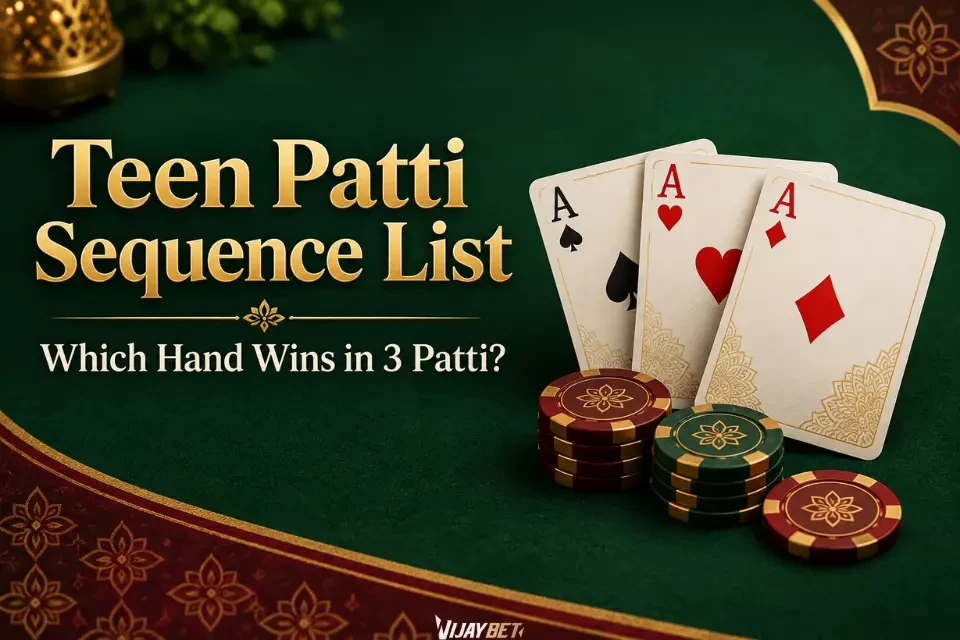
Three cards are enough to create several different Teen Patti hands, but comparing them is not always as simple as checking the highest card. A Pair can beat an Ace-high hand, a Sequence ranks above a Colour, and a Trail defeats every other standard combination.
That is why learning the correct Teen Patti Sequence order matters. It helps players recognise the winning hand during a Show and prevents Poker rules from being mistakenly applied to 3 Patti.
This guide covers the complete sequence list, common tie-breakers and the A-K-Q versus A-2-3 debate using terms familiar to Indian players.
Table of contents


- How the Teen Patti Hand Ranking Works
- Complete 3 Patti Sequence List from Highest to Lowest
- Is A-K-Q or A-2-3 the Highest Teen Patti Sequence?
- Teen Patti Tie-Breaker Rules: Which Hand Wins in a Tie?
- Common Mistakes When Comparing 3 Patti Hands
- Frequently Asked Questions About 3 Patti Sequences
- Check the Sequence Order Before the First Bet
How the Teen Patti Hand Ranking Works
Every player receives three cards. If the game reaches a Show, the cards are arranged into one of six standard hand categories.
The Teen Patti Hand Ranking from highest to lowest is:
Rank | Teen Patti hand | Example |
| 1 | Trail or Trio | A♠–A♥–A♦ |
| 2 | Pure Sequence | A♠–K♠–Q♠ |
| 3 | Sequence | J♠–10♦–9♣ |
| 4 | Colour | A♥–9♥–5♥ |
| 5 | Pair | Q♠–Q♦–7♣ |
| 6 | High Card | A♣–J♦–8♠ |
The category is always compared before individual card values. Therefore, even the lowest Pair beats an Ace-high hand because Pair is a higher category.
Similarly, a Sequence beats a Colour in standard Teen Patti. This differs from Poker, where a Flush normally ranks above a Straight.
Complete 3 Patti Sequence List from Highest to Lowest
Understanding the order is only the beginning. Players must also know how two hands within the same category are compared.
1. Trail or Trio (Three of a Kind)
A Trail, also known as a Trio or Three of a Kind, contains three cards of the same rank.
Examples include:
- A♠–A♥–A♦
- K♣–K♥–K♦
- 7♠–7♥–7♣
Trail is the highest hand in the standard 3 Patti Sequence List. When two players have a Trail, the rank of the three matching cards decides the winner.
For example, three Kings beat three Queens. The highest possible Trail is A-A-A, while the lowest is 2-2-2.
Suits do not normally affect the result because all three cards have the same rank.
2. Pure Sequence (Straight Flush)
A Pure Sequence contains three consecutive cards from the same suit. Some online tables may also call it a Straight Flush.
Examples include:
- A♠–K♠–Q♠
- J♥–10♥–9♥
- 6♣–5♣–4♣
Pure Sequence ranks below Trail but above a regular Sequence. The highest-ranking cards in the combination are used to compare two Pure Sequences.
For example, J-10-9 beats 9-8-7.
However, players should check how a table ranks A-K-Q and A-2-3. Both combinations are normally valid, but their exact positions may differ between platforms.
3. Sequence or Run (Straight)
A Sequence, also called a Run or Straight, contains three consecutive cards that do not all belong to the same suit.
Examples include:
- A♠–K♦–Q♣
- 10♥–9♣–8♦
- 5♣–4♥–3♠
The highest card in the Sequence normally determines its strength. Thus, Q-J-10 beats 8-7-6.
A regular Sequence always loses to a Pure Sequence, even when both combinations contain the same card ranks. For example, 8♠–7♠–6♠ beats 8♥–7♣–6♦ because the first hand is pure.
An Ace can generally be used at the top in A-K-Q or at the bottom in A-2-3. However, combinations such as K-A-2 and Q-A-2 are not standard Sequences.
4. Colour (Flush)
A Colour contains three cards from the same suit, but the cards are not consecutive.
Examples include:
- A♣–J♣–7♣
- K♥–9♥–4♥
- 10♠–6♠–2♠
When two players have a Colour, their highest cards are compared first. If those cards are equal, the second-highest cards are checked. The third card is compared if the first two are also equal.
For example, A-J-7 beats A-10-9 because the Jack is higher than the 10.
Indian players commonly use the term Colour, while some international platforms display Flush. Both names refer to the same type of Teen Patti hand.
5. Pair (Two of a Kind)
A Pair contains two cards of the same rank and one unmatched card.
Examples include:
- A♠–A♦–8♣
- J♥–J♣–6♦
- 5♠–5♥–K♣
The paired cards are compared first. A Pair of Kings, therefore, beats a Pair of Queens regardless of the third card.
If two players have the same Pair, the unmatched card acts as the kicker. For example, 10-10-A beats 10-10-K because the Ace kicker is higher.
Although a Pair may look less impressive than three cards of one suit, it still beats every High Card hand.
6. High Card
A High Card hand does not form a Trail, Pure Sequence, Sequence, Colour or Pair.
Examples include:
- A♠–J♦–8♣
- K♥–10♣–4♠
- 9♦–7♣–2♥
The highest card is compared first. If it is equal, the second-highest card decides the result. When necessary, the third card is also compared.
For instance, A-J-8 beats A-J-6. Both hands contain an Ace and a Jack, but 8 is higher than 6.
High Card is the lowest standard Teen Patti category. Even A-K-J loses to a Pair of Twos.
Is A-K-Q or A-2-3 the Highest Teen Patti Sequence?
This is one of the most debated questions among 3 Patti players.
In many traditional versions, A-K-Q is the highest Sequence, followed by A-2-3 and then K-Q-J. Under that order, the ranking begins:
- A-K-Q
- A-2-3
- K-Q-J
- Q-J-10
However, some online tables recognise A-2-3 as the highest Sequence. Others may place it below A-K-Q or treat it according to their own variation.
There is no reason to guess. Check the platform’s game information before joining a table, especially when playing a variation with Jokers or modified ranking rules.
The same issue applies to both Pure Sequences and regular Sequences.
Teen Patti Tie-Breaker Rules: Which Hand Wins in a Tie?
When two players hold the same hand category, the following comparison rules generally apply:
Same category | Standard tie-breaker |
| Trail | Higher set of three cards wins |
| Pure Sequence | Higher sequence wins |
| Sequence | Higher sequence wins |
| Colour | Compare highest, second and then third card |
| Pair | Higher Pair wins; kicker breaks an equal Pair |
| High Card | Compare cards from highest to lowest |
Consider two Colour hands: A-10-6 and A-10-4. The Ace and 10 are equal, so the third card decides the result. A-10-6 wins.
For equal Pairs, Q-Q-9 beats Q-Q-7 because the 9 kicker is higher.
Most standard Teen Patti games do not assign permanent values to suits. In other words, Spades do not automatically beat Hearts, and Hearts do not automatically beat Diamonds. If two hands remain equal after all relevant ranks are compared, the pot may be split or settled according to the platform’s Show rules.
Because tie policies can vary, the published rules of the table always take priority.
Common Mistakes When Comparing 3 Patti Hands
Many players assume that Colour beats Sequence because Poker uses that ranking. In standard Teen Patti, the opposite is true: Sequence is higher than Colour.
Another common mistake is focusing only on the biggest card. An Ace-high hand may look strong, but any Pair defeats it. The hand category must be identified before individual cards are compared.
Players may also overlook the kicker when two hands contain the same Pair. Additionally, some assume A-2-3 always holds the same position on every platform, even though this rule can change.
Special variations require extra attention. Muflis rewards lower hands, while Joker versions can alter the combinations that players are able to form. The regular sequence list should not be applied automatically to every variation.
Frequently Asked Questions About 3 Patti Sequences
- Q1:What is the highest hand in Teen Patti?
Trail is the highest standard Teen Patti hand. A Trail of three Aces—A-A-A—is generally the strongest possible combination. It defeats every Pure Sequence, Sequence, Colour, Pair and High Card hand. - Q2:Is Trail higher than a Pure Sequence?
Yes. Any valid Trail beats a Pure Sequence. For example, 2-2-2 defeats A-K-Q of the same suit because the hand category ranks above Pure Sequence. - Q3:Does Colour beat Sequence in Teen Patti?
No. A regular Sequence ranks above Colour in standard Teen Patti. For example, 7♠–6♦–5♣ beats A♥–J♥–8♥, even though the Colour contains an Ace. - Q4:Is A-2-3 higher than A-K-Q in 3 Patti?
It depends on the table rules. Many versions place A-K-Q first and A-2-3 second, while some platforms rank A-2-3 as the highest Sequence. Players should confirm the order before playing. - Q5:Which Pair wins if two players have the same Pair?
The unmatched third card decides the result. If both players have a Pair of Nines, 9-9-A beats 9-9-K because the Ace kicker is higher.
Check the Sequence Order Before the First Bet
The standard Teen Patti Sequence order is Trail, Pure Sequence, Sequence, Colour, Pair and High Card. Remembering this hierarchy makes it easier to follow a Show and compare similar-looking hands correctly.
However, knowing the sequence cannot guarantee a win. Cards are dealt randomly, while the ranking of A-K-Q and A-2-3 may vary between tables. Before joining a Teen Patti game on VijayBet, check the table rules and betting limits, then play with a fixed entertainment budget instead of chasing losses.

Read More
Teen Patti Sequence List: Which Hand Wins in 3 Patti?
India vs South Africa Cricket Test Update: South Africa Set a 549 Target as India Fight for Survival

Discover the Best Online Betting Sites for Real Money Games in India