






Rummy Points Calculation: How Penalty Scores Work


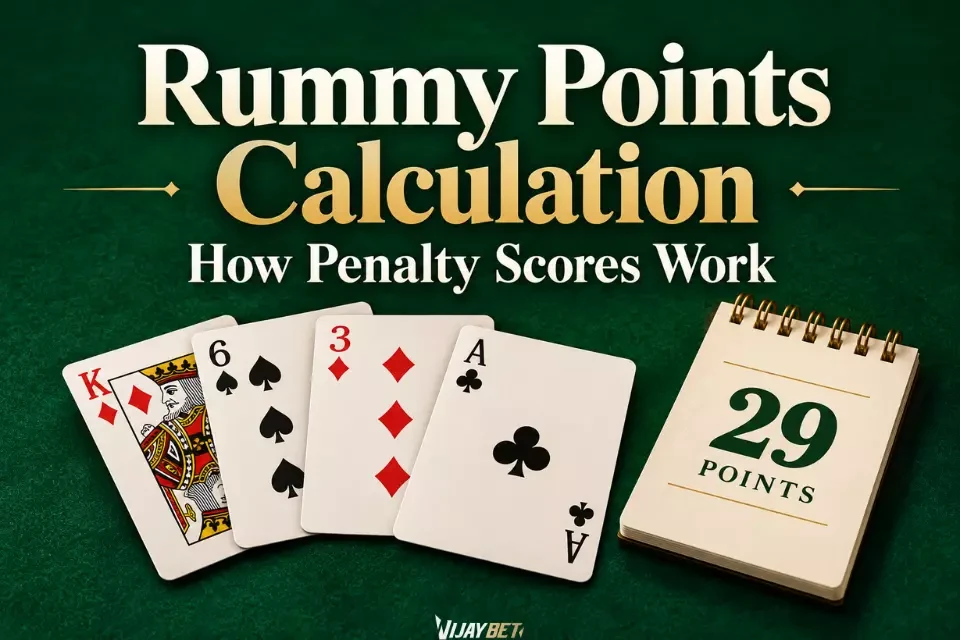
A Rummy hand may look almost complete and still carry a sizeable penalty. Your final score depends on more than card values: you also need to check whether you have completed the required sequences and whether the result comes from normal hand scoring, a drop or an invalid declaration.
Understanding rummy points calculation starts with identifying which cards count towards your penalty, then adding their values. This guide covers common scoring rules for 13-card Indian Rummy. Always check your table’s rules, as details can differ between formats.
Table of contents


- Basic Card Values: An Ace Is Not Always One Point
- Which Cards Can Be Excluded from Your Penalty?
- Full-Hand Example: How the Score Becomes 29 Points
- The Same Hand Can Receive a Different Penalty for an Invalid Declaration
- Drop Penalties and the 80-Point Cap
- Frequently Asked Questions About Rummy Points Calculation
- Check Your Hand Before You Count the Points
Basic Card Values: An Ace Is Not Always One Point
When a card counts towards your penalty, these are its common values:
Card | Common penalty value |
| Number cards from 2 to 10 | Face value |
| J, Q and K | 10 points each |
| A | Usually 10 points |
| Printed Joker and Wild Joker | 0 points |
For example, unmatched cards K, 8 and 3 add up to:
10 + 8 + 3 = 21 points.
An Ace can form part of a sequence such as A–2–3. However, that does not automatically make an unmatched Ace worth one point. Under the commonly used scoring method followed here, it carries 10 penalty points.
Which Cards Can Be Excluded from Your Penalty?
You cannot simply add the cards that look ungrouped. First, check whether you have completed the required sequences.
A standard valid declaration generally requires all 13 cards to be arranged into valid groups, with at least two sequences, including one pure sequence.
Under the scoring method used in this article, eligible sequences and sets can be excluded from your penalty once the sequence requirement is met.
If you have not completed the required sequences, do not automatically exclude every group you have formed. In particular, published rules can differ on what is excluded when you have one pure sequence but no second sequence. Check your table’s scoring instructions before calculating.
Full-Hand Example: How the Score Becomes 29 Points
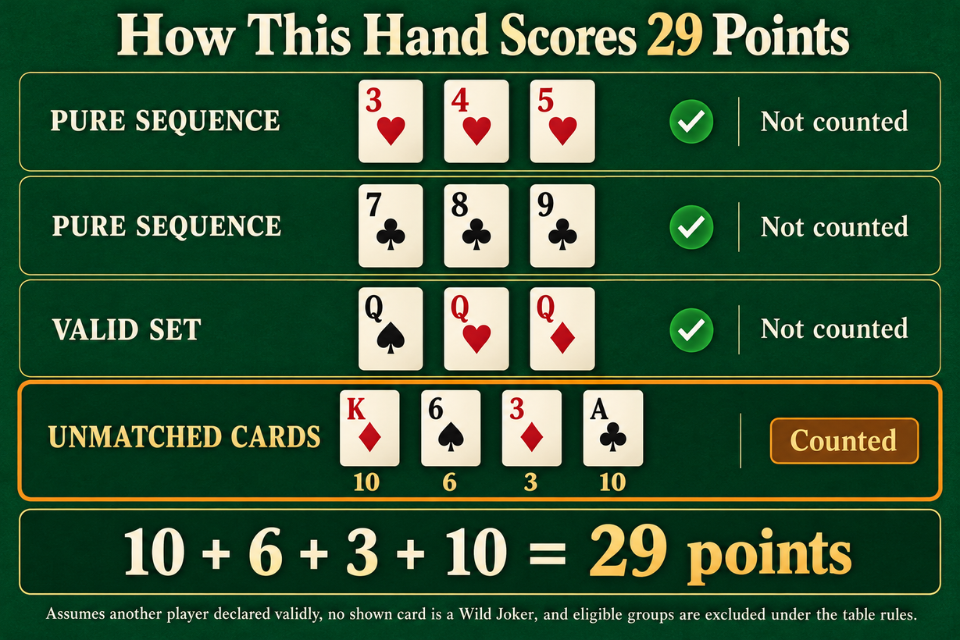
Suppose an opponent has made a valid declaration. These are your remaining 13 cards, and none of the cards shown is the designated Wild Joker for this deal:
Group | Cards | Classification |
| First group | 3♥–4♥–5♥ | Pure sequence |
| Second group | 7♣–8♣–9♣ | Pure sequence |
| Third group | Q♠–Q♥–Q♦ | Valid set |
| Remaining cards | K♦, 6♠, 3♦, A♣ | Unmatched cards |
First, check your two required sequences. Both are valid pure sequences, so the sequence requirement is satisfied.
Next, check the three Queens. They form a valid set because they have the same rank and different suits.
Under the stated scoring method, these completed groups are excluded. Only the four unmatched cards count:
K♦ + 6♠ + 3♦ + A♣
10 + 6 + 3 + 10 = 29 points.
Your normal losing-hand penalty is therefore 29 points. You do not add the values of the sequences or the three Queens again.
The Same Hand Can Receive a Different Penalty for an Invalid Declaration
If an opponent declares validly and you submit this hand for scoring, its penalty is 29 points under the method above.
But suppose you declare this unfinished hand yourself, claiming that all your cards are correctly grouped. That can be treated as an invalid declaration, because four cards remain unmatched.
Some rules apply a fixed 80-point penalty for an invalid declaration instead of calculating the value of your unmatched cards.
So, a hand worth 29 points during normal scoring does not necessarily receive a 29-point penalty if you declare it incorrectly.
Drop Penalties and the 80-Point Cap
Some Points Rummy rules use the following fixed penalties:
Situation | Example penalty |
| First Drop | 20 points |
| Middle Drop | 40 points |
| Invalid declaration | 80 points |
These figures are not universal. Pool Rummy may use different drop penalties, and you should check the conditions that distinguish a First Drop from a Middle Drop.
Also, an 80-point cap does not mean every losing hand scores 80 points.
If the applicable rules cap a normal hand penalty at 80, a calculated score of 92 becomes 80. A calculated score of 29 remains 29.
A scoring cap limits a calculated penalty. A fixed penalty assigns a specific score to an action, such as an invalid declaration. Keep these two rules separate.
Frequently Asked Questions About Rummy Points Calculation
- Q1. Does the Player with the Lowest Penalty Win?
No. In a standard hand of 13-card Indian Rummy, a player must make a valid declaration to win. Having fewer penalty points than another losing player does not make you the winner. For formats played across several deals, the overall result depends on the format’s rules. - Q2. Does a 29-Point Penalty Mean ₹29?
No. Points are the game’s scoring unit, not automatically a rupee amount. If a format assigns a monetary value to each point, that value must be applied separately according to its settlement rules. Never assume that one point equals one rupee. - Q3. Is an Ace Worth One Point or 10 Points?
Under commonly used Indian Rummy scoring rules, an unmatched Ace carries 10 penalty points. Although an Ace can form the low end of a sequence such as A♥–2♥–3♥, its position in that sequence does not automatically change its unmatched-card penalty to one point. - Q4. Does Every Losing Player Receive 80 Points?
No. Where an 80-point cap applies, it limits the calculated hand penalty. A score of 29 remains 29, while a score above 80 is capped at 80. An invalid declaration may attract a fixed 80-point penalty under some rules, which is a separate situation. - Q5. Can I Exclude Every Completed Set from My Score?
Not automatically. In rummy points calculation, whether a completed set can be excluded depends on the required sequence conditions and your table’s rules. Do not subtract every grouped card without checking those conditions, especially if you have a pure sequence but no second sequence.
Check Your Hand Before You Count the Points
Accurate rummy points calculation starts with checking your sequences and sets. Identify which cards count towards your penalty, add their values and apply any relevant scoring cap. Remember that drops and invalid declarations may carry fixed penalties instead.
Explore more Rummy guides on VijayBet to better understand valid combinations, declaration requirements and scoring rules before your next game.

Read More
Rummy Points Calculation: How Penalty Scores Work

JILI Slot RTP and Volatility: What the Numbers Mean for Your Budget

Master Online Baccarat Game - Play for Free or Real Money

