






Pure Sequence vs Impure Sequence in Rummy: Can You Spot a Valid Hand?


You have arranged all 13 cards into groups. The hand looks complete, so you tap Declare—only to find that your declaration is invalid. What went wrong?
In Indian 13-card rummy, arranging every card is only part of the job. You need at least two sequences, including one pure sequence. The remaining cards must also form valid sequences or sets. The difference between a pure and an impure sequence is often what decides whether your hand is ready


What Is a Pure Sequence in Rummy?
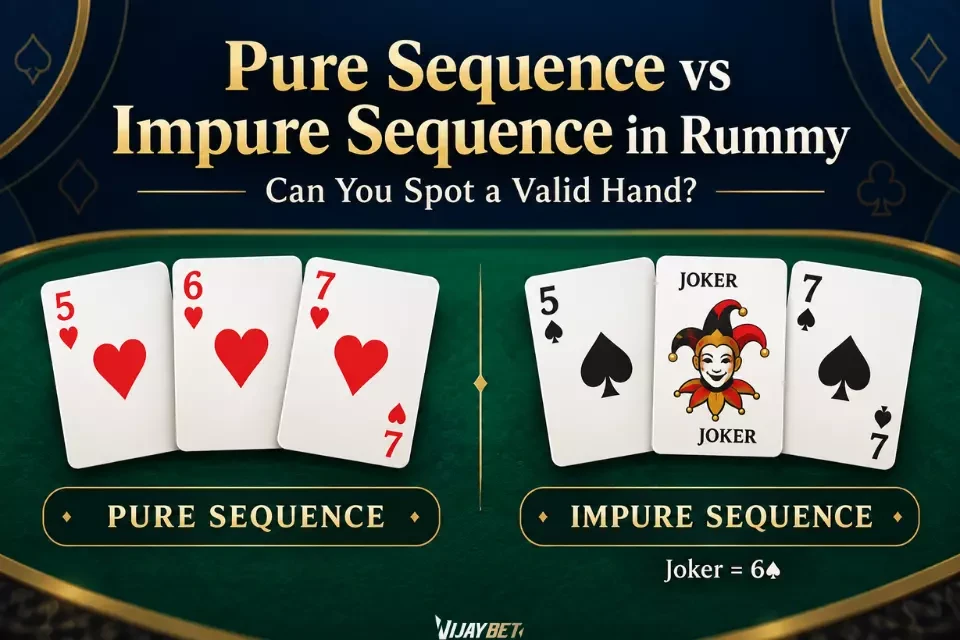
A sequence contains three or more consecutive cards of the same suit. For example, 5♥, 6♥, 7♥ is a sequence: all three cards are hearts, and their ranks follow one another.
It is a pure sequence because no Joker is used to replace a missing card. You must have at least one such sequence before making a valid declaration in a standard 13-card rummy game.
Do not check the numbers alone. 5♥, 6♦, 7♥ is not a sequence, because the 6 belongs to a different suit. Likewise, 5♥, 7♥, 8♥ is incomplete: the 6♥ is missing.
How Is an Impure Sequence Different?
An impure sequence uses a Joker to stand in for a missing card. Suppose you hold 5♥, Joker, 7♥. If the Joker represents 6♥, those three cards form a valid impure sequence.
The Joker helps you complete the run, but it does not make that run pure. This distinction matters when you declare:
Cards | Result | Why |
| 5♥, 6♥, 7♥ | Pure sequence | Consecutive hearts; no Joker replaces a card |
| 5♥, Joker, 7♥ | Impure sequence | Joker stands in for 6♥ |
| 5♥, 6♦, 7♥ | Invalid sequence | The cards are not all the same suit |
| 5♥, 7♥, 8♥ | Invalid sequence | 6♥ is missing |
Your second required sequence may be pure or impure. But if both of your sequences depend on Jokers and you have no pure sequence elsewhere in the hand, you are not ready to declare.
Can You Declare This 13-Card Hand?
Try checking this hand one group at a time:
Group | Cards | What it forms |
| 1 | 3♦, 4♦, 5♦ | Pure sequence |
| 2 | 8♠, 9♠, Joker | Impure sequence; Joker represents 10♠ |
| 3 | Q♥, Q♣, Q♦ | Set of three Queens |
| 4 | 6♣, 7♣, 8♣, 9♣ | Pure sequence |
There are 13 cards in total: three in the first group, three in the second, three in the third and four in the last. The hand has a pure sequence, a second sequence, and valid groups for every remaining card. Under the standard rules described above, it can be declared.
Now imagine changing 3♦, 4♦, 5♦ to 3♦, Joker, 5♦. Group 1 becomes impure. Is the declaration automatically invalid? No. Group 4—6♣, 7♣, 8♣, 9♣—is still a pure sequence, so the hand still meets that requirement.
That is why you must inspect the whole hand, rather than deciding whether it is valid based on one group.
Why Do Hands That Look Complete Fail?
One common mistake is treating a set as a sequence. Q♥, Q♣, Q♦ is a valid set because the three cards share a rank and have different suits. It does not count as one of your two required sequences.
Another mistake is overlooking a Joker. A run may look like 8♠, 9♠, 10♠ after you arrange it on screen, but if the “10♠” is actually a Joker standing in for that card, the sequence is impure.
Players also sometimes leave one card unmatched while focusing on their first two sequences. A pure sequence and a second sequence are essential, but they do not make a declaration valid if the rest of the hand cannot be arranged into valid groups.
Some games select a card rank as a wild Joker for that round. A card of that rank may have different treatment depending on whether it is used as its original card or as a substitute. Check the rules shown for your table before relying on a borderline arrangement.
A Quick Check Before You Declare
Read your hand in this order:
- Find a pure sequence. Are there at least three consecutive cards of one suit without a Joker replacing any card?
- Find another sequence. This one may use a Joker.
- Check every remaining card. Does each card belong to a valid sequence or set?
- Count the cards. Have you accounted for all 13 cards in your final arrangement?
Jokers give you more ways to finish a hand, but they cannot solve every declaration problem. If you have not identified a pure sequence, keep checking your cards before you tap Declare.
Conclusion
The easiest way to check a rummy hand is to find its pure sequence first. Then look for a second sequence and account for every remaining card. Once you can tell when a Joker is completing a run, it becomes much easier to spot a hand that looks finished but is not yet valid.
Ready to practise spotting pure and impure sequences? Explore Rummy on Vijaybet and check the rules of your chosen table before you play.
.

Read More
Pure Sequence vs Impure Sequence in Rummy: Can You Spot a Valid Hand?

Virat Kohli in IPL: 10 Legendary Moments Fans Will Never Forget

Learn How to Play Baccarat Game - Simple and Easy to Master!