






How Do Jokers Work in Indian Rummy? Printed and Wild Joker Examples


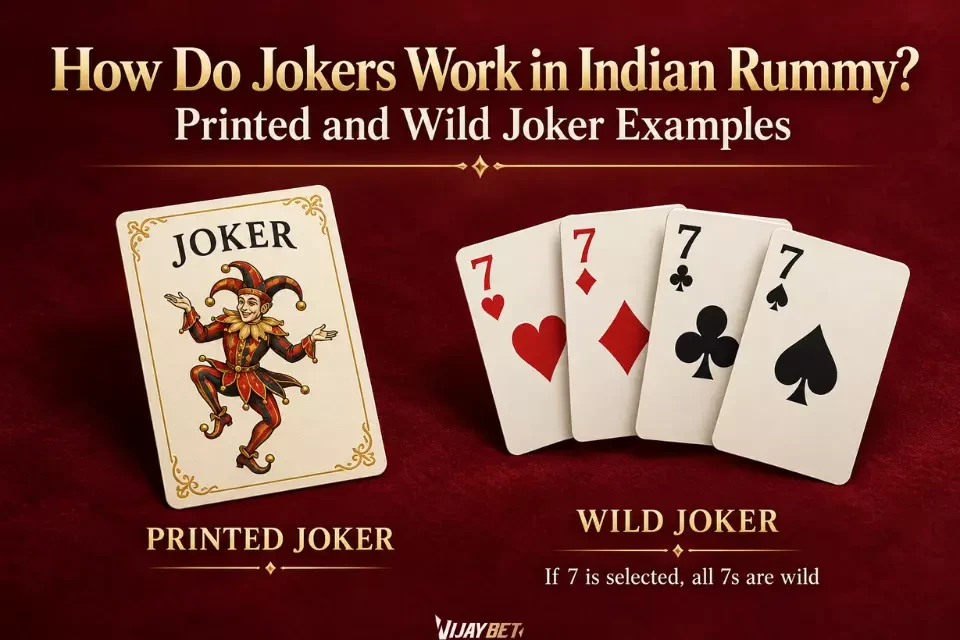
You pick up a regular 7 during an Indian Rummy game, but the screen marks it as a Joker. Is something wrong?
Usually, no. Indian Rummy uses two types of Jokers: the printed Joker that comes with the deck and the wild Joker selected for that round. Both can help you complete a group, but understanding Rummy Joker rules means knowing exactly which card each Joker represents.
Having several Jokers does not automatically make your hand ready to declare. You still need valid sequences and sets, including the required pure sequence.


Printed Joker vs Wild Joker: What Is the Difference?
A printed Joker is the card with a jester illustration or the word “JOKER” on its face. It has no regular rank or suit and works as a substitute for a missing card.
A wild Joker is an ordinary playing card whose rank is selected as wild for that round.
For example, if the selected card is 7♦, all cards of rank 7—7♥, 7♦, 7♣ and 7♠—can act as Jokers. It is not limited to the selected suit. A different rank may become wild in the next round.
Joker Type | How to Identify It | How It Works |
| Printed Joker | Jester artwork or “JOKER” text | Replaces a missing card in a group |
| Wild Joker | A regular card matching the round’s selected wild rank | Can replace another card; some rules also allow it to be used naturally |
Before arranging your hand, check the selected wild rank on the table. Otherwise, you could discard a useful Joker without realising it.
How Do Jokers Complete a Sequence?
A sequence consists of at least three consecutive cards of the same suit, and a Joker can replace a missing card to form an impure sequence.
For example, 5♥, 6♥ and a printed Joker work when the Joker represents 7♥. If 7 is the wild rank, 9♣, 7♦, J♣ also form an impure sequence, with 7♦ replacing 10♣. The wild Joker’s original suit does not restrict which card it can replace.
However, 5♥, 6♦ and a Joker do not form a valid sequence because the two natural cards have different suits. Before placing a Joker, identify the exact card it represents—such as 10♣—and check that the resulting sequence is consecutive and belongs to one suit.
Can a Joker Complete a Set?
Yes. A set is a group of cards of the same rank, with different suits.
For example, Q♥, Q♣ and a printed Joker can form a valid set. The Joker may represent Q♦.
But a Joker cannot fix duplicate natural cards already inside the group. Q♥, Q♥ and a Joker are not a valid set under the usual rules, because the two natural Queens have the same suit.
Indian Rummy commonly uses more than one deck, so you may receive two identical cards. That does not make them different suits or allow both to count naturally within the same set.
Does a Wild Joker Always Make a Sequence Impure?
Not always. The key is whether the card is used as itself or as a substitute.
Suppose 7 is the wild rank and you hold 6♥, 7♥, 8♥. These cards already form a consecutive heart sequence. Under the rules published by Rummy.com, 7♥ can be used at its original rank and suit, allowing this group to remain a pure sequence.
Compare that with 6♥, 7♣, 8♥. Here, the wild 7♣ replaces 7♥, so the group is an impure sequence.
Wild Rank | Cards | Role of the Wild Card | Result |
| 7 | 6♥, 7♥, 8♥ | 7♥ is used naturally | Pure sequence, where the table permits natural use |
| 7 | 6♥, 7♣, 8♥ | 7♣ replaces 7♥ | Impure sequence |
A printed Joker has no natural rank or suit, so it cannot form a pure sequence in this way. Check your chosen table’s rules before relying on natural use of a wild card.
Where Should You Place Your Joker?
Before placing a Joker, arrange your natural cards and identify the groups that are already complete.
Suppose you have:
- 4♠, 5♠, 6♠
- 9♦, 10♦
- One printed Joker
The spade sequence is already complete. You can use the Joker with 9♦ and 10♦, representing J♦, to complete another sequence.
This approach helps you preserve your pure sequence while using the Joker where a card is missing. You may also be able to move a Joker between groups as your hand develops, provided every final group remains valid.
Before declaring, check all 13 cards again. Standard Indian 13-card Rummy requires at least two sequences, including one pure sequence, with the remaining cards arranged into valid sequences or sets. Jokers help complete those groups, but they do not remove the declaration requirements.
Conclusion
The easiest way to understand Jokers in Indian Rummy is to ask: “Which card does this Joker represent?”
A printed Joker acts as a substitute. A wild Joker can also act as a substitute, while some rules allow it to retain its original rank and suit within a pure sequence. Understanding that difference makes it easier to check your hand and avoid an invalid declaration.
Ready to practise arranging your cards? Explore the game information on VijayBet , check your chosen table’s Joker rules and start building valid Rummy hands.

Read More
How Do Jokers Work in Indian Rummy? Printed and Wild Joker Examples

2024 IPL: Complete Royal Challengers Bangalore (RCB) Team Roster & Player Information

8 Moments Indian Cricket Fans Will Never Forget from the ICC Women’s World Cup