




Gin Rummy Rules: How to Play and Win Your First Game


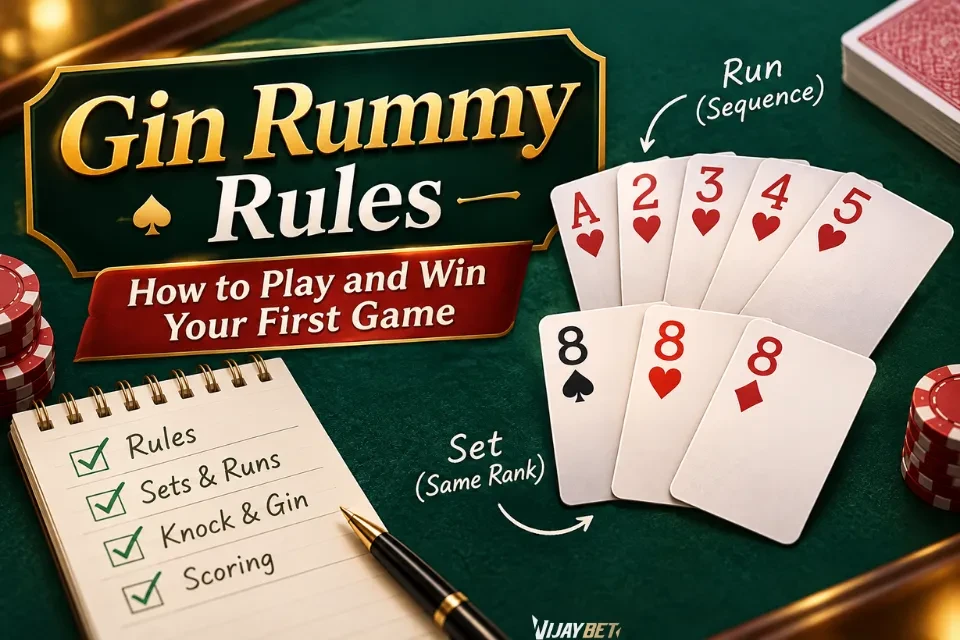
Gin Rummy is a two-player card game where the aim is to arrange your cards into matching sets and sequences while keeping unmatched cards to a minimum. Unlike Indian Rummy, which commonly uses 13 cards per player, Gin Rummy is played with 10 cards and has different rules for ending a round.
If you already know the basics of Rummy, learning Gin Rummy rules should feel familiar. However, knowing when to knock, how to reduce deadwood points and when to go for Gin can make a significant difference.
This guide explains how to play Gin Rummy, understand valid card combinations, calculate scores and avoid common beginner mistakes.
Table of contents


- What Is Gin Rummy and How Does It Work?
- How to Set Up a Gin Rummy Game
- How to Play Gin Rummy Step by Step
- Understanding Gin, Knock and Deadwood
- How Does Scoring Work in Gin Rummy?
- Common Mistakes Beginners Should Avoid
- Frequently Asked Questions About Gin Rummy
- Learn the Rules Before Your First Gin Rummy Game
What Is Gin Rummy and How Does It Work?
Gin Rummy is a traditional draw-and-discard card game usually played between two people. Players take turns collecting useful cards and discarding unwanted ones to build valid combinations called melds.
The objective is to finish a round with fewer unmatched card points than your opponent or achieve Gin by arranging all 10 cards into valid melds.
How Many Players Can Play Gin Rummy?
Standard Gin Rummy requires two players and one regular deck of 52 cards, without jokers.
Each player receives 10 cards, while the remaining cards form the stock pile. One card is placed face up to begin the discard pile.
Unlike many Indian Rummy formats, Gin Rummy does not use printed or wild jokers in its standard rules.
What Is the Objective of the Game?
Players aim to create two types of card combinations:
- Sets: Three or four cards of the same rank, such as 7♠, 7♥ and 7♦.
- Runs: Three or more consecutive cards of the same suit, such as 4♣, 5♣ and 6♣.
Cards that do not belong to a valid set or run are called deadwood.
The fewer deadwood points you hold, the better your position when ending a round.
How to Set Up a Gin Rummy Game
Understanding the card arrangement is the first step before learning how to play Gin Rummy.
Both players should be familiar with the stock pile, discard pile and basic drawing rules.
Cards, Dealing and the Stock Pile
The dealer shuffles the deck and distributes 10 cards to each player. The remaining cards are placed face down to form the stock pile.
The next card is turned face up to start the discard pile.
The non-dealer gets the first opportunity to take this face-up card. If they pass, the dealer may accept it. If both players pass, the non-dealer draws from the stock pile.
How the Discard Pile Works
The discard pile contains face-up cards that players have discarded.
During a normal turn, players may take the top card from this pile instead of drawing an unknown card from the stock.
However, a player cannot pick up the top discard and immediately throw that same card back during the same turn.
How to Play Gin Rummy Step by Step
Once the cards are dealt, players alternate turns until somebody knocks, goes Gin or the round ends without a score.
Drawing and Discarding Cards
Each normal turn follows a simple pattern:
- Draw one card from the stock pile or the top of the discard pile.
- Examine your 11 cards and look for useful sets or runs.
- Discard one card face up to return your hand to 10 cards.
- Decide whether you can end the round by knocking or going Gin.
Players generally keep their melds hidden until the round ends.
Creating Sets and Runs
Suppose you hold the following cards:
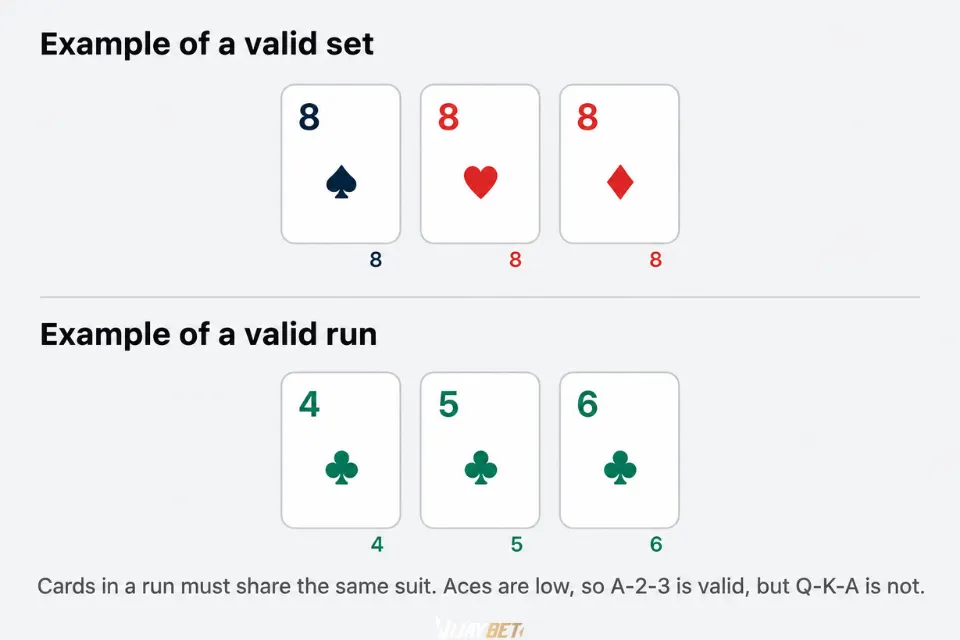
Unlike Indian Rummy, standard Gin Rummy does not require a pure sequence before ending a round.
When Can You End a Round?
A player can end a round by knocking when their remaining deadwood totals 10 points or fewer.
Alternatively, a player may go Gin when all 10 cards form valid melds, leaving no deadwood.
Under standard rules, a round also ends without scoring when only two cards remain in the stock pile and neither player has ended the hand.
Understanding Gin, Knock and Deadwood
These three terms are central to Gin Rummy rules because they determine how a round finishes and which player receives points.
What Does Going Gin Mean?
Going Gin means arranging all 10 cards into valid sets or runs without leaving any deadwood.
For example, a player might complete two three-card sets and one four-card run.
Going Gin usually earns an additional bonus, and the opponent cannot lay off unmatched cards onto the Gin player's melds.
When Can You Knock?
A player may knock when their deadwood is worth 10 points or fewer after discarding.
For example, if your unmatched cards are 3♠ and 5♥, your deadwood total is eight points.
You may knock rather than waiting for another card.
However, your opponent can potentially score an undercut if their deadwood is equal to or lower than yours after any permitted layoffs.
What Are Deadwood Cards?
Deadwood refers to cards that cannot be included in your completed melds.
Their values are straightforward:
Card | Deadwood value |
| Ace | 1 point |
| Number cards 2–10 | Face value |
| Jack | 10 points |
| Queen | 10 points |
| King | 10 points |
For instance, holding an unmatched King, 6 and Ace gives you 17 deadwood points.
Reducing these points is important because high deadwood can prevent you from knocking.
How Does Scoring Work in Gin Rummy?
Gin Rummy scoring depends on how the round ends. Knock, Gin and Undercut produce different results.
The following examples use a common ruleset with 25-point Gin and Undercut bonuses. Some versions use different bonus values.
Card Game Rules+1
Deadwood Points and Card Values
When a player knocks successfully, their opponent can lay off eligible unmatched cards onto the knocker's melds.
The remaining deadwood totals are then compared.
For example:
Scoring situation | Result |
| Player A knocks with 5 deadwood; Player B finishes with 15 | Player A earns 10 points |
| Player A goes Gin; Player B holds 18 deadwood | Player A earns 43 points, including a 25-point bonus |
| Player A knocks with 8 deadwood; Player B has 6 | Player B earns 27 points, including a 25-point Undercut bonus |
Gin Bonuses and Undercuts
Going Gin generally produces a higher reward because the player has no unmatched cards.
An Undercut works differently. It occurs when the opponent finishes with deadwood equal to or lower than the knocking player's total.
For beginners, this explains why knocking immediately is not always the best decision.
A standard match is often played until one player reaches 100 points, although final match scoring and target totals may vary.
Common Mistakes Beginners Should Avoid
Learning the basic rules is relatively easy, but poor card decisions can cost valuable points.
Holding Too Many High-Value Cards
Keeping Kings, Queens and Jacks without a clear plan can increase your deadwood quickly.
If these cards are unlikely to form a meld, discarding them early may help reduce your potential losses.
However, avoid following the same discard pattern every round, as your opponent may recognise your strategy.
Discarding Cards Without Watching Your Opponent
The discard pile provides useful information about an opponent's possible combinations.
If your opponent picks up 7♥, they may be building a set of sevens or a run involving nearby hearts.
Paying attention to these moves can help you decide which cards are safer to discard.
Frequently Asked Questions About Gin Rummy
- Q1:Can two people play Gin Rummy?
Yes. Standard Gin Rummy is specifically designed for two players, with each receiving 10 cards. - Q2:Is Gin Rummy easy to learn?
Yes. The basic drawing, discarding and melding rules are straightforward. The main challenge is learning when to knock and how to manage deadwood. - Q3:Can you knock with zero deadwood?
A hand with zero deadwood is normally declared Gin rather than an ordinary knock, allowing the player to receive the applicable Gin bonus. - Q4:Does Gin Rummy use jokers?
No. Standard Gin Rummy uses a 52-card deck without jokers. This differs from many Indian Rummy variations. - Q5:How long does a Gin Rummy game last?
A single round may take only a few minutes, while a complete match can take longer depending on player decisions, target scores and the number of rounds played.
Learn the Rules Before Your First Gin Rummy Game
Understanding Gin Rummy rules begins with three fundamentals: building valid melds, reducing deadwood and recognising the right time to end a round.
You do not need to chase Gin on every hand. Sometimes, knocking with a low deadwood total is the more practical choice.
If you want to explore more card games, visit VijayBet and check the available game selection. Before playing, read the specific table rules, scoring conditions and bonus values, as these may differ between versions. Where practice or demo options are available, use them to become comfortable with the gameplay before considering real-money participation.

Read More
Gin Rummy Rules: How to Play and Win Your First Game

IPL 2024 Comprehensive Roster: Unveiling Delhi Capitals' (DC) Strategic Player Lineup

Real Money Gaming Ban in India: Full List of Affected Platforms (Live Updates)